



Connect with us
Office of Sustainability
Rockwell Integrated Sciences Center Room 203
746 High Street
Easton PA, 18042
sustainability@lafayette.edu
746 High Street
Easton PA, 18042
sustainability@lafayette.edu
As climate impacts intensify in frequency and severity, Lafayette recognizes that achieving carbon neutrality alone is not sufficient to safeguard its campus, community, and academic mission from long-term climate impacts.

CAP 3.0 expands beyond emissions reduction to emphasize climate resilience and adaptation to ensure Lafayette’s physical infrastructure, operations, and community are prepared to withstand climate‐related disruptions.
Learn more about Lafayette’s Resiliency & Adaptation strategies in Section 9 of the full Climate Action Plan 3.0.
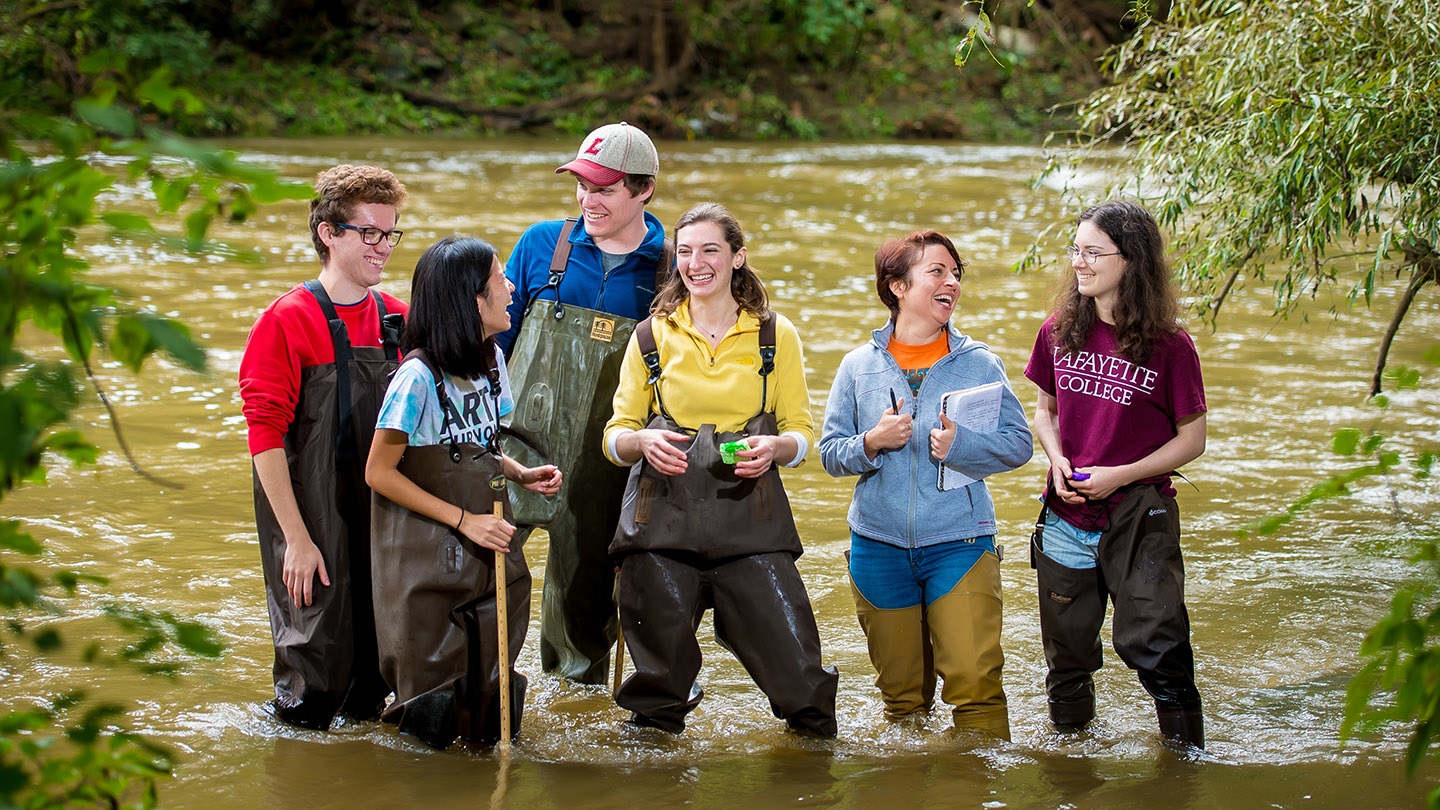
The Bushkill Creek Greenway is a nature‐based resiliency solution focused on reducing flood risk, stabilizing streambanks, and enhancing biodiversity along the Bushkill Creek corridor adjacent to Lafayette’s campus.

As climate projections indicate increasing rainfall intensity and riverine flooding in the Bushkill Creek watershed, this solution is designed to protect vulnerable campus assets, like the rowing facilities and arts campus, while delivering long‐term ecological and community benefits.
In the coming years, Lafayette will invest in riparian buffer enhancement, bioswale restoration (sloped channels with vegetation intended to capture stormwater runoff), and wetland rehabilitation along the creek’s edge.
These interventions restore the natural floodplain’s ability to absorb and slow stormwater, reduce erosion, and improve water quality by filtering pollutants before they enter the creek.
The Campus Core Cooling Network is a nature‐based climate adaptation strategy designed to help Lafayette combat extreme heat events and rising summer temperatures.
Lafayette will install a network of passive, nature‐based cooling solutions, including green roofs, street trees for shade, and vertical gardens (living walls).
Together, these features reduce ambient temperatures, provide shading, and improve building envelope performance, delivering localized cooling during warm months without relying on energy‐intensive mechanical systems.
Green stormwater infrastructure is a nature‐based resiliency opportunity that manages rainfall by slowing, absorbing, storing, and reusing stormwater across Lafayette’s campus.
This solution is designed to reduce rainfall‐driven flooding, alleviate pressure on stormwater systems, and improve water quality while delivering biodiversity and campus co‐benefits.

Lafayette would deploy a suite of distributed green stormwater features, including bioswales, permeable pavements, flood buffers, rain gardens, and on-site stormwater retention and reuse systems.
These elements capture runoff during heavy rainfall events, restore groundwater, and reduce downstream flooding risks while supporting biodiversity and improving water quality.
The Parking Lot Transformation is a climate resiliency strategy that reimagines existing campus parking areas as multifunctional, climate‐adaptive infrastructure.

By retrofitting select parking lots with permeable surfaces, expanded tree canopy, and electric vehicle (EV) charging, this solution addresses extreme heat and heavy rainfall flooding while supporting Lafayette’s broader decarbonization and campus experience goals.
These improvements allow stormwater to infiltrate where it falls, reduce surface temperatures, and modernize parking assets to align with the EV transition for direct emissions reduction.
Adopting these climate resiliency and nature‐based adaptation measures will create substantial experiential learning opportunities by embedding hands‐on climate adaptation work directly into Lafayette’s campus environment.

Students will be able to participate in field‐based research and applied projects related to flood mitigation, urban heat reduction, biodiversity restoration, and stormwater management, supporting coursework in environmental studies, ecology, engineering, public health, urban planning, and data science.
Educational opportunities will be further enhanced by coordinating with federally recognized Lenape nations, who care deeply about healing the homeland.
Particularly, the Bushkill Creek Greenway presents a unique opportunity to partner with the Lenape nations on plant species selection and signage around the greenway in Lenape/Delaware language.
